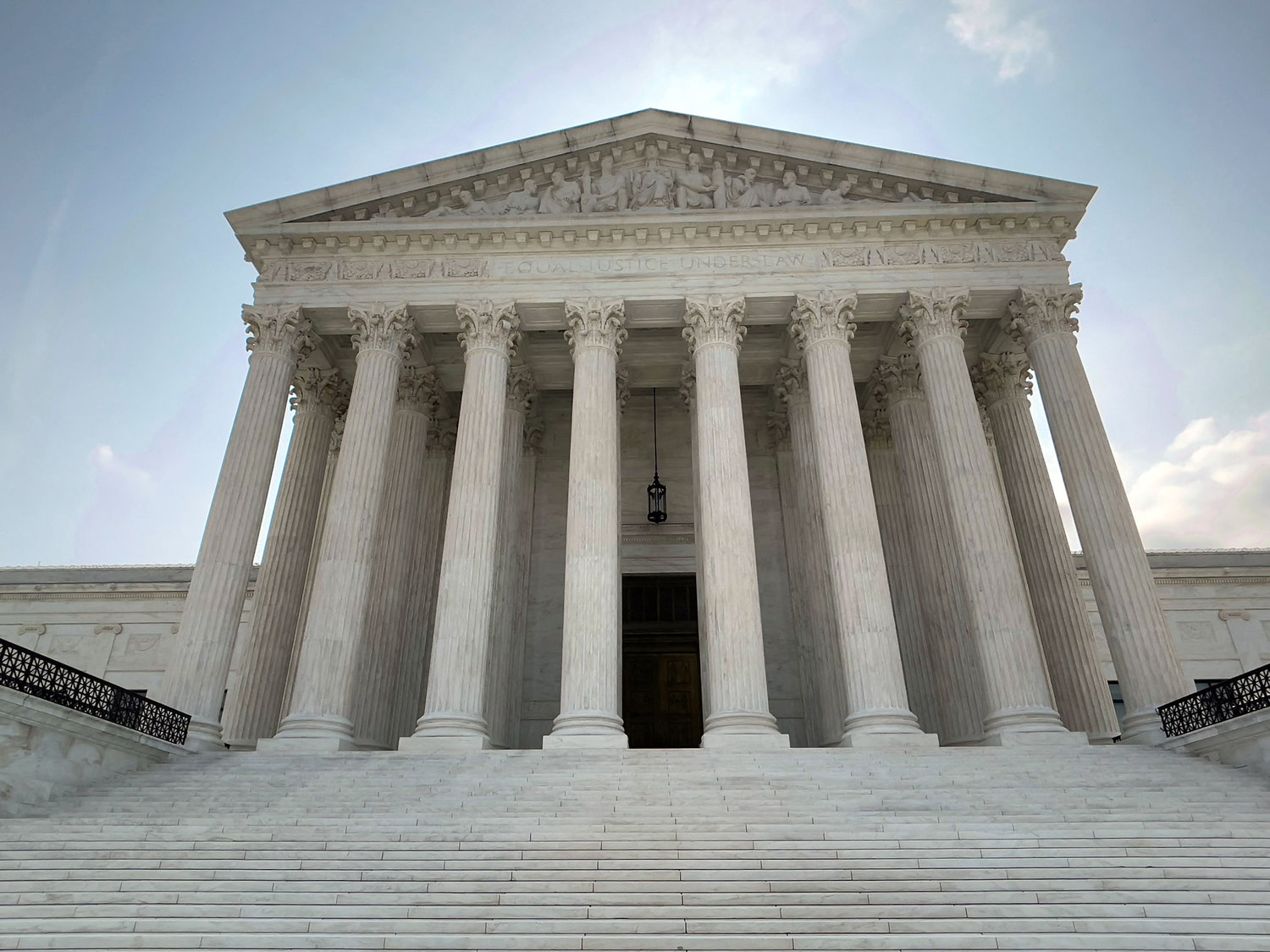
The U.S. Supreme Court next year could overturn state bans on semiautomatic rifles that would invalidate laws in a dozen states, including the ban passed by Washington lawmakers in 2023.
The court announced that next term it will hear a case that consolidates two legal challenges to semiautomatic rifle bans: a Cook County prohibition that predates the broader Illinois ban, and one from Connecticut.
The court’s decision in late June was welcome news to Alan Gottlieb, founder and executive vice president of the Bellevue-based Second Amendment Foundation. A nonprofit started in 1974, the foundation is powering the two rifle ban cases that have been accepted by the court.
“We think they would not have taken these cases if they weren’t going to overturn the lower court rulings and get rid of the ban,” Gottlieb said. “What it means is the bans in approximately 12 states and Washington, D.C., are going to bite the dust.”
Since becoming a reliably conservative-leaning institution in 2021, the Supreme Court has issued several consequential rulings loosening the regulation of firearms. In a 2022 decision, the nation’s highest court changed criteria for how lower-court judges should decide Second Amendment-related cases.
And in June, the justices issued two more opinions, holding that cannabis users are not automatically barred from owning guns and knocking down a Hawaiʻi law requiring people to get permission before carrying guns into places like hotels and stores.
The nation’s highest court is stepping into the gun question in an era where progressives have increasingly viewed gun violence and firearm deaths as a public health emergency.
Amid high-profile mass shootings around the nation and the accompanying media coverage, lawmakers in Democratic-leaning states have sought to make it harder or impossible to buy weapons like the AR-15.
The Connecticut law, for example, stems from the early 1990s and was strengthened after the 2012 Sandy Hook Elementary School shooting left 20 children and six adult staff members dead.
In 2023, Washington lawmakers and then-Gov. Jay Inslee approved a ban on the manufacture, sale, transfer, importation and distribution of 62 models defined as “assault weapons,” including AK-47s, AR-15s and other rifles, as well as some other weapons, like semiautomatic shotguns.
For Inslee, the state law was a bookend coming nearly 30 years after he voted to approve the federal assault weapons ban passed in 1994. He lost his Central Washington congressional seat later that year in the red wave that brought Newt Gingrich to power; Inslee has long attributed his loss to that vote.
The federal ban expired after a decade, and Democratic majorities in Congress have struggled to muster the votes to pass another. In 2022, the U.S. House under a Democratic majority passed a new ban, but it stalled in the U.S. Senate.
Now, a decision by the Supreme Court could take such policies permanently off the table.
U.S. Sen. Patty Murray, D-Wash., voted for the federal rifle ban in 1994. She’s also a sponsor of a new proposed federal ban, which has gone nowhere in the Republican-controlled Congress.
It was incredibly challenging, we were getting lobbied constantly, there was a lot of pressure," Murray said in an interview in July with The Seattle Times, on the original federal ban. "But underlying that was the understanding that people have a right to be in their streets, in their communities without this kind of threat that was killing people."
“I still believe to this day that weapons of war have no place on our streets and in our communities,” she added. “And we need gun safety laws.”
Looking to history
Four appeals courts have upheld prohibitions on semiautomatic rifles, which fire a round every time the trigger is squeezed. Last month, a fifth appeals court struck down New Jersey's rifle ban.
As the Supreme Court debate gets underway, those arguing for and against the rifle bans are debating on at least two major fronts.
First, the question is whether weapons like the AR-15 rifle are “in common use” and protected under the Second Amendment.
Gottlieb points to the fact that the AR-15 is one of the most popular rifles in America.
"Our argument is they’re commonly owned, there’s no reason to ban them, they’re seldom used in crime," he said.
A brief to the Supreme Court by the state of Connecticut, in defense of its rifle ban, takes issue with that characterization.
The "evidence showed that only a tiny percentage of Americans own assault weapons and that they are not useful and almost never used for self-defense, refuting any notion that Americans commonly choose them for that purpose," according to the brief.
Another front comes from the high court’s 2022 ruling, known as the Bruen decision. The decision itself invalidated a New York state law that required gun owners to demonstrate a valid reason to get a license for carrying a concealed firearm in public.
But the justices also held that judges must look to laws from the early American republic.
"When the Second Amendment’s plain text covers an individual’s conduct, the
Constitution presumptively protects that conduct," the court wrote in the majority opinion. "The government must then justify its regulation by demonstrating that it is consistent with the Nation’s historical tradition of firearm regulation."
The justices of the high court have been "pretty clear that it will not rely on a tradition that didn’t start at least (until) the 1800s,” said Jacob Charles, an associate law professor at Pepperdine University's Caruso School of Law.
“But the modern assault weapons ban in federal law, and more restrictive regulations in the early 1900s, those can count as part of a continuing tradition, but they couldn’t be the start of a tradition,” he added.
Justice Brett Kavanaugh has stated that there's a “strong argument that AR-15s are in 'common use' by law-abiding citizens and therefore are protected by the Second Amendment.” Kavanaugh's remarks came in a statement last year by the court when it declined to hear a case challenging Maryland's rifle ban.
Based on past rulings, Charles said the justices likely to become the deciding factor in the rifle ban are Amy Coney Barrett and Chief Justice John Roberts.
Reform the political process?
State Rep. Strom Peterson, a Democrat from Edmonds who sponsored the state's rifle ban in the Legislature, said he's concerned about what the court will do.
Peterson represents Mukilteo, where in 2016 a man who had recently bought an AR-15 killed three people and injured a fourth at a house party. The killer read the rifle manual outside the house before he went in and started shooting. The episode pushed voters to tighten regulations on semiautomatic rifles via ballot measure, before lawmakers ultimately banned their sale in 2023.
"I’m certainly nervous, concerned that this court will overturn commonsense gun legislation, as they’ve been a pretty activist court on a whole host of issues," Peterson said. "And that will mean communities that are less safe. It’s that simple."
Given the Supreme Court’s lifetime appointments, Democratic legislators are wondering how to keep laws and policies they've passed from being overruled. Peterson thinks the country needs campaign finance reform to stop huge amounts of money from influencing public policy.
Murray, who said she is concerned about having a partisan Supreme Court, is co-sponsoring a bill with other Democrats that would impose 18-year term limits on Supreme Court judges.
“So we don’t put somebody in a lifetime appointment and they serve for 50 years, and are not held accountable for where the country has changed or moved to,” she said. “Or thought about where the country is at the moment.”
When the Legislature passed the rifle ban in 2023, state Rep. Jim Walsh, R-Aberdeen, predicted the high court might strike it down. Walsh, also the state Republican Party chair, is ranking member on a legislative committee that handles firearms proposals.
“They’re clearly infringements, impairments of the individual’s right to keep and bear arms,” Walsh said last month. “And I suspect the court will, even if it’s not unanimous, will probably rule in favor of their unconstitutionality.”
Walsh hopes that after striking down a ban on rifles, the Supreme Court will go after prohibitions on high-capacity ammunition magazines, like the law passed in Washington in 2022 that prohibited magazines that hold more than 10 rounds.
A legal challenge to that law — sometimes referenced by the Kelso firearms shop at the center of the case, Gator’s Custom Guns — was dismissed last year by the state Supreme Court. That case has a pathway to get to the federal high court, he said.
Added Walsh: “I wouldn’t be surprised if our hometown case, Gator’s Guns, could end up being the case that goes all the way up to the Supreme Court.
© 2026 The Seattle Times. Visit www.seattletimes.com. Distributed by Tribune Content Agency, LLC.



